

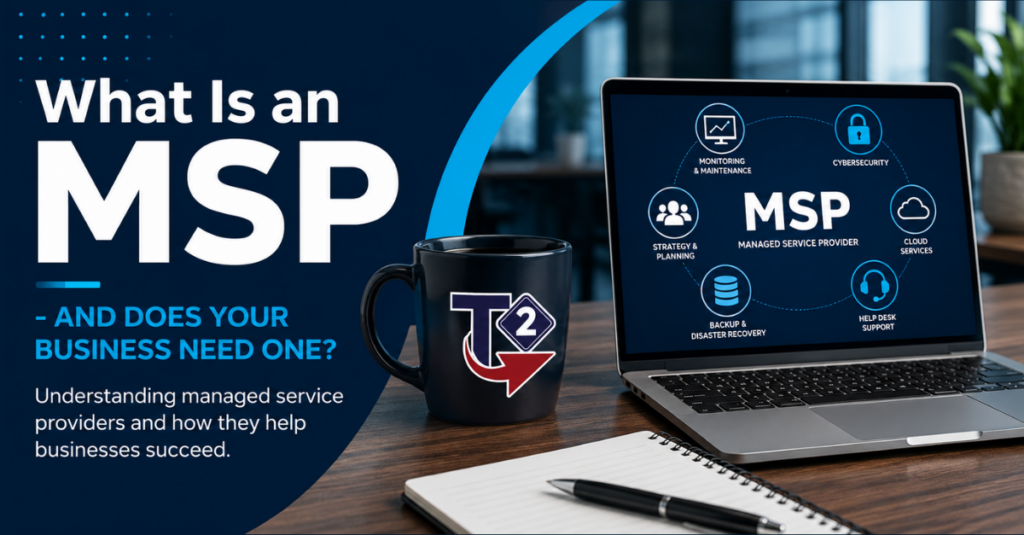
If you’ve spent any time looking for IT support for your business, you’ve probably come across the term MSP. Like a lot of technology acronyms, it’s often used without much explanation.
So, what exactly is an MSP – and does your business actually need one?
What Is an MSP?
MSP stands for Managed Service Provider. Simply put, an MSP is an outside company that manages some or all of a business’s ongoing technology needs.
The key word is ongoing.
Traditional IT support was often reactive: something stopped working, you called someone to fix it, and everyone moved on until the next problem appeared.
An MSP takes a more proactive approach. Instead of only responding when something breaks, an MSP can help maintain, monitor, secure, and support your technology on an ongoing basis.
What Does an MSP Actually Do?
The answer varies depending on the provider and what your business needs. An MSP may help manage areas such as:
- Cloud services and data storage
- Microsoft 365 and email
- Cybersecurity and firewalls
- Data backup and recovery
- Network monitoring and maintenance
- Employee technology support
- Software and system updates
- Technology planning
You may not need help with every item on that list. That’s part of the point.
An MSP relationship can be built around the areas where your business needs additional expertise or support rather than requiring you to manage every piece of your technology the same way.
Does an MSP Replace In-House IT?
Not necessarily.
For a smaller business without dedicated IT staff, an MSP may handle most of its day-to-day technology needs.
For a company with an IT person or department, an MSP can provide additional expertise, coverage, tools, or support. Internal IT might focus on the company’s systems and strategic priorities while the MSP manages specific areas such as cybersecurity, cloud infrastructure, backups, or Microsoft services.
And some organizations have the resources and expertise to manage everything internally.
The right approach depends on the size of your business, the complexity of your technology, and the resources you already have available.
How Do I Know if My Business Could Benefit From an MSP?
You don’t need to wait for a major outage or security incident to reconsider how you’re managing IT.
It may be worth exploring managed services if:
- No one clearly owns your company’s IT responsibilities.
- Employees regularly lose time troubleshooting technology problems.
- You’re relying on several different technology vendors with no one overseeing the bigger picture.
- Backups, updates, or cybersecurity measures are handled inconsistently.
- Your technology has become more complicated as your business has grown.
- Most IT decisions happen only after something goes wrong.
- Your internal IT team needs additional expertise or capacity.
The common thread isn’t necessarily that your technology is bad. It’s that managing it has become a job of its own.
What Should I Look for in an MSP?
Choosing an MSP isn’t just about finding someone who can fix a computer.
Start by asking how the provider approaches your technology as a whole. Do they primarily respond to individual problems, or are they looking for ways to prevent those problems? Can they support the systems you use today while helping you plan for what you’ll need tomorrow?
Security should also be part of the conversation from the beginning – not something added after everything else. Ask about backups, recovery, monitoring, cybersecurity, response times, and what happens when something goes wrong.
Most importantly, make sure you understand who is responsible for what. A good managed services relationship should make technology easier to manage, not add another layer of confusion.
From IT Support to Technology Partner
Businesses today rely on more technology than ever: email, cloud storage, cybersecurity, connectivity, websites, business applications, backups, and countless other systems.
When each piece is managed separately, it’s easy to end up with a collection of vendors and tools without anyone looking at how everything works together.
That’s where the value of the right MSP goes beyond troubleshooting.
An MSP isn’t just who you call when technology breaks. The right MSP helps keep technology from becoming a problem in the first place.
At Tech 2 Success, we take a broader approach to technology – helping businesses manage the systems they rely on while optimizing how those systems work together. The goal isn’t to add more technology, it’s to enable technology solutions that support the way your business actually works.
Not sure whether managed services make sense for your business?
Talk to Tech 2 Success about your current technology environment and where you could use additional support.