
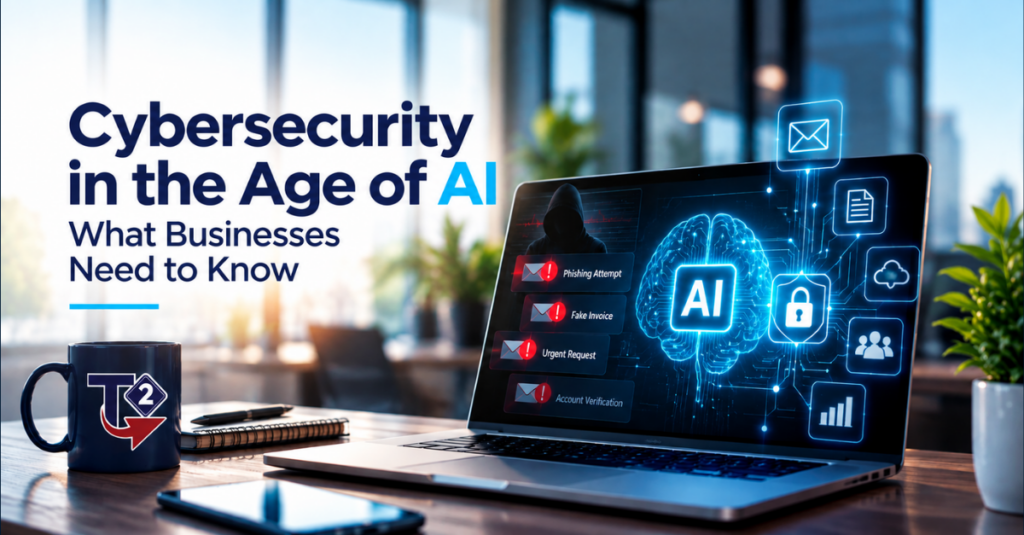
Artificial intelligence is changing the way businesses work.
Employees are using AI to write emails, summarize information, analyze data and complete everyday tasks faster. Businesses are exploring new ways to automate processes and improve productivity.
But AI is changing something else at the same time: Cybersecurity threats.
The same technology that can help businesses work more efficiently can also help cybercriminals create more convincing phishing attempts, impersonate trusted people and scale attacks faster than before.
That doesn’t mean businesses should be afraid of AI. It means cybersecurity practices need to evolve alongside it.
Phishing Is Getting Harder to Spot
For years, employees have been taught to watch for familiar phishing warning signs.
Poor grammar. Strange wording. Misspelled company names. Emails that simply don’t sound like something a legitimate organization would send.
AI can make those clues less obvious.
Generative AI can help attackers create polished, professional messages in seconds. Those messages can be tailored to specific industries, job functions or situations, making them potentially more believable than the generic phishing emails employees have learned to recognize.
That changes the question employees need to ask.
Instead of simply looking for an email that looks fake, they increasingly need to consider whether the request itself makes sense.
Why is this person asking me to reset my password? Was I expecting this document? Is this normally how this vendor requests payment? Should I verify this request another way?
That kind of critical thinking becomes increasingly important as fake messages become more convincing.
Seeing – or Hearing – Isn’t Always Believing
AI-generated content also extends beyond written messages.
Voice cloning and deepfake technology can imitate real people, creating another opportunity for impersonation and social engineering.
Imagine receiving an urgent request that appears to come from an executive, coworker or customer.
The voice sounds familiar. The message seems urgent. And you’re being asked to transfer money, provide sensitive information or take an unusual action.
Traditionally, recognizing the person’s voice might have provided reassurance. In the age of AI, that alone may not be enough.
Businesses may need verification procedures for sensitive requests—particularly those involving financial transactions, credentials or confidential information.
AI Creates Internal Risks, Too
Not every AI-related cybersecurity concern comes from an attacker.
Employees now have access to an enormous number of AI tools, and it isn’t always obvious what happens to information entered into them.
An employee trying to save time might paste customer information, internal documents, proprietary data or other sensitive material into an AI service without realizing the potential implications.
That’s why businesses need clear policies around approved AI tools and appropriate data use.
Employees shouldn’t have to guess which tools are acceptable or what information they can safely share. AI governance is becoming part of cybersecurity.
The Fundamentals Still Matter
AI may be changing the threat landscape, but it hasn’t made traditional cybersecurity practices obsolete.
In many cases, it makes them even more important.
Multi-factor authentication can provide another barrier when credentials are compromised. Email security can help identify and filter suspicious messages. Firewalls and properly maintained systems help protect the technology employees depend on. Backup and recovery strategies help businesses respond when prevention isn’t enough.
And security awareness training can evolve to teach employees about newer tactics alongside traditional phishing threats.
AI changes how some attacks are created and delivered. It doesn’t change the need for layers of protection.
Don’t Fight AI. Prepare for It.
AI will continue becoming part of everyday business. Trying to avoid it entirely isn’t a realistic cybersecurity strategy. A better approach is understanding where the risks are changing and adjusting accordingly.
Review how employees verify unusual requests. Establish guidelines for using AI tools. Continue strengthening account security. Update security awareness training to reflect emerging tactics. And make sure there is a plan for responding when something gets through.
Cybersecurity has always evolved alongside technology. AI is simply the next major shift.
The businesses that benefit most from AI won’t necessarily be the ones that adopt every new tool first. They’ll be the ones that learn how to use it without forgetting to protect the people, systems and information behind it.
Tech 2 Success helps businesses take a proactive approach to cybersecurity with managed IT support, email security, security awareness training, backup and recovery, and other layers of protection designed to help businesses adapt as technology changes.
Cybersecurity threats are evolving. Is your security strategy evolving with them? Contact Tech 2 Success to start the conversation or take our no-obligation Cybersecurity Self Assessment.